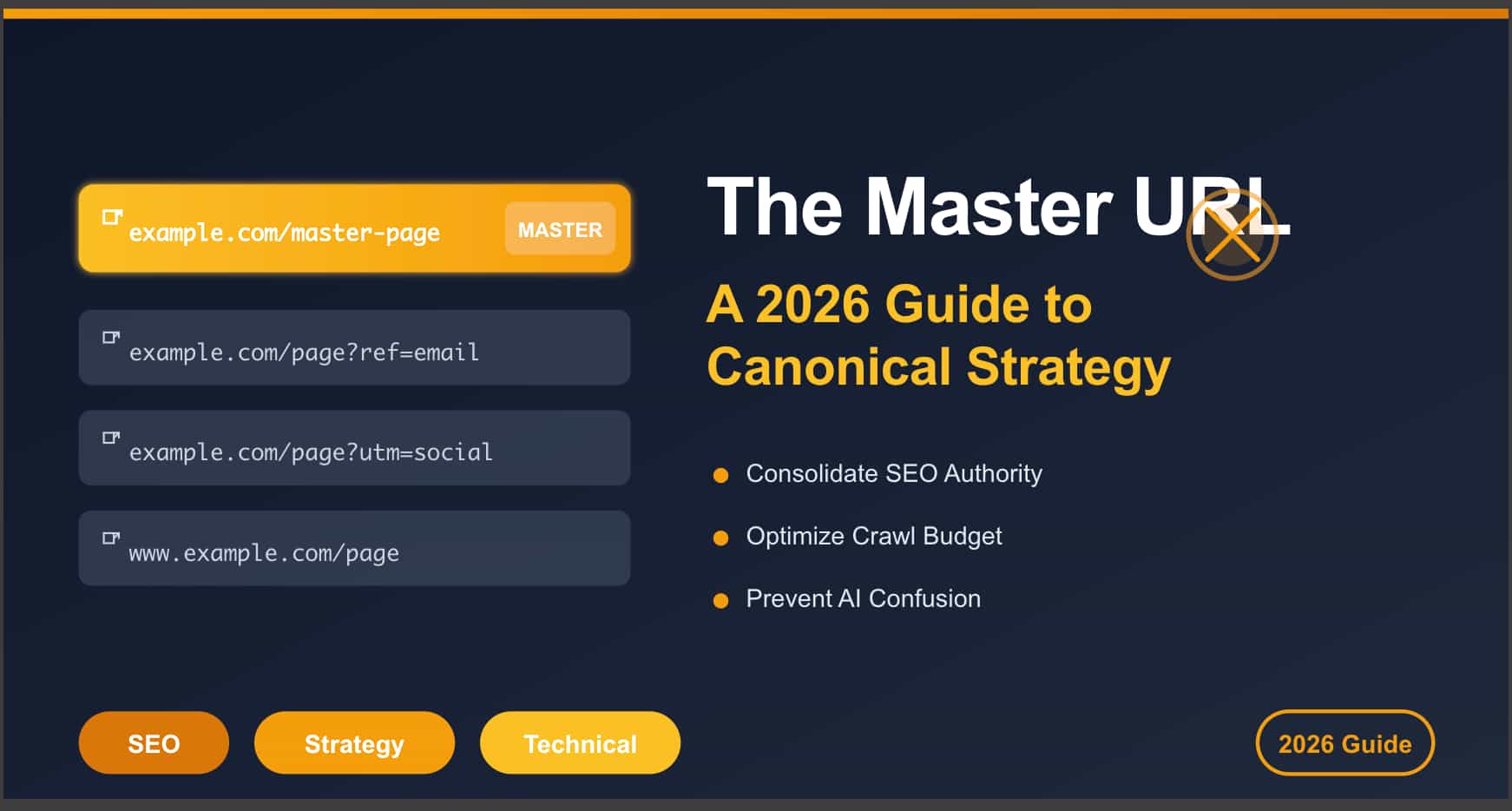
In the evolving landscape of 2026, where generative AI and search engines ingest billions of data points daily, the "Identity Crisis" of a website is its greatest vulnerability. A canonical URL is the definitive "source of truth" for a webpage, acting as a traffic director for both human users and AI crawlers.
The Why: The Problem Before the Solution
Why do we even need to designate a "canonical" version? Without one, your site suffers from three primary ailments:
Diluted Authority: The studentFirst Case Study
The Problem:
On studentFirst, a learning platform for Nigerian A-level students (JUPEB and IJMB), we discovered that a single past exam question page was accessible through multiple URLs:
https://studentfirst.ng/jupeb/past-question/mathematics/2023/objective
https://studentfirst.ng/jupeb/past-question/mathematics/2023/objective?subject=mathematics
https://studentfirst.ng/jupeb/past-question/mathematics/2023/objective?year=2023
https://studentfirst.ng/jupeb/past-question/mathematics/2023/objective?program=jupeb&year=2023
https://www.studentfirst.ng/jupeb/past-question/mathematics/2023/objective
The Investigation:
-
Google Search Console Analysis: We noticed the same question appearing multiple times in search results, each with different URLs. Our analytics showed users landing on various URL variations, but none ranking well.
-
Crawl Log Review: Googlebot was spending 40% of its crawl budget on these duplicate variations instead of indexing new content. We found 2,847 duplicate URLs for just 500 unique questions.
-
Ranking Impact: A highly valuable JUPEB Mathematics objective question from 2023 that should have ranked #3 for "JUPEB Mathematics 2023 Objective Questions" was split across 5 URLs, each ranking between positions #18-25. Combined, they had enough authority to easily reach the top 3, but split apart, they were invisible.
-
User Experience: Students sharing links would get different URLs, making it impossible to track which questions were most popular or needed updates.
The Solution:
We implemented canonical tags pointing all variations to the clean master URL:
<link
  rel="canonical"
  href="https://studentfirst.ng/jupeb/past-question/mathematics/2023/objective"
/>
The Result:
- Within 3 weeks, the master URL consolidated all ranking signals and jumped to position #2
- Crawl budget efficiency improved by 35% - Googlebot now indexed 40% more new content
- User engagement increased as all traffic funneled to a single, trackable URL
- Internal linking became consistent, further boosting authority
The Lesson: Search engines don't automatically know that ?subject=math and the base URL are the same page. Without explicit canonical signals, they treat each variation as a separate entity, diluting your hard-earned SEO authority across multiple weak pages instead of one strong page.
Crawl Budget Waste
Search bots have limited time. If they spend all their time crawling 5,000 variations of your product filters, they may never find your new, high-value blog posts.
AI Confusion
Modern generative engines need a single reference point to summarize accurately. Inconsistent URLs lead to "hallucinations" or outdated information being served as "official".
The Solution: How to Signal Preference
The industry standard for 2026 is a multi-layered approach to ensure search engines never have to guess.
The HTML Canonical Tag
The primary tool is a snippet of code in the <head> of your HTML.
Agnostic Pseudo-Code Example:
<!-- On EVERY version of the page, point to the master one -->
<link rel="canonical" href="https://example.com/master-page-url/" />
Framework-Specific Implementations
The canonical tag works the same across all frameworks, but each has its own way of generating URLs dynamically. Here are practical examples for popular frameworks:
Next.js (App Router):
// app/product/[slug]/page.tsx
import { Metadata } from "next";

export async function generateMetadata({ params }): Promise<Metadata> {
  const { slug } = await params;
  const baseUrl = process.env.NEXT_PUBLIC_BASE_URL || "https://example.com";

  return {
    alternates: {
      canonical: `${baseUrl}/product/${slug}`,
    },
  };
}
Next.js (Pages Router):
// pages/product/[slug].tsx
import Head from "next/head";

export default function ProductPage({ product }) {
  const canonicalUrl = `https://example.com/product/${product.slug}`;

  return (
    <>
      <Head>
        <link rel="canonical" href={canonicalUrl} />
      </Head>
      {/* ... */}
    </>
  );
}
Django:
from django.urls import reverse

class Product(models.Model):
    slug = models.SlugField()

    def get_absolute_url(self):
        return reverse('product_detail', kwargs={'slug': self.slug})
<!-- Template -->
<link
  rel="canonical"
  href="{{ request.build_absolute_uri:product.get_absolute_url }}"
/>
React (with React Helmet):
import { Helmet } from "react-helmet";

function ProductPage({ product }) {
  const canonicalUrl = `https://example.com/product/${product.slug}`;

  return (
    <>
      <Helmet>
        <link rel="canonical" href={canonicalUrl} />
      </Helmet>
      {/* ... */}
    </>
  );
}
Express.js (Node.js):
app.get("/product/:slug", (req, res) => {
  const canonicalUrl = `https://example.com/product/${req.params.slug}`;

  res.send(`
    <html>
      <head>
        <link rel="canonical" href="${canonicalUrl}" />
      </head>
      <!-- ... -->
    </html>
  `);
});
Rails (Ruby):
# app/views/products/show.html.erb
<%= tag.link rel: "canonical", href: product_url(@product) %>
The key principle is the same across all frameworks: generate the absolute URL dynamically and include it in the <head> section of every page variation.
Scenario-Based Solutions
| Scenario | The Problem | The Solution |
|---|---|---|
| E-commerce Filters | .../shoes?size=10&color=blue | Canonicalize back to the main .../shoes page. |
| Tracking Codes | .../post?utm_source=email | Canonicalize to the clean .../post URL. |
| Syndication | Your post is copied to Medium.com | Medium adds a canonical tag pointing back to your site. |
| Old Page Merge | Two small posts become one big guide | Use a 301 Redirect instead of a canonical tag. |
Best Practices for 2026
- Absolute URLs Only: Never use relative paths like
/page. Always usehttps://example.com/page. - Self-Reference: Even unique pages should point to themselves as canonical to prevent scrapers from claiming ownership.
- Single Tag Rule: Never have more than one canonical tag on a page, or search engines will ignore both.
- HTTPS Priority: In 2026, always prefer the secure
httpsversion overhttp. - Consistency: Your XML sitemap, internal links, and canonical tags must all point to the same version of the URL.